
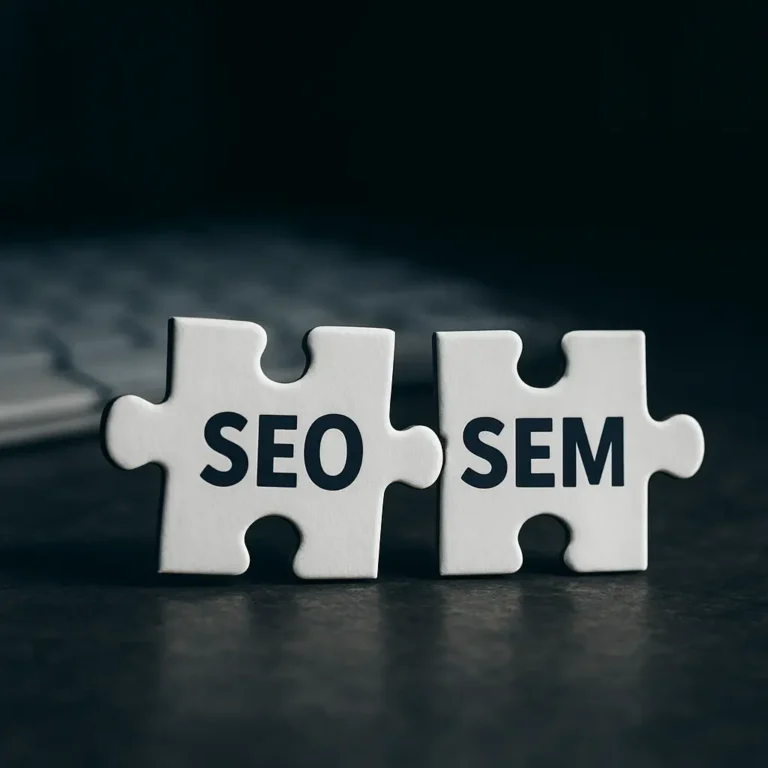
SEO and SEM complement each other when they share objectives, search data and landing pages. SEO focuses on organic visibility; here, we use SEM to mean search advertising. To combine them, assign each channel a role based on intent, budget and timeframe, and measure their joint contribution to inquiries and sales.
For years, SEO and SEM have been presented as almost opposing disciplines, as though one were the patient, noble side of digital marketing and the other a fast track funded by investment. That view is incomplete. In practice, the best-performing brands understand when, why and how to combine them. The problem is strategic: many companies handle organic search on one side and search advertising on the other, ending up duplicating effort, competing with themselves or misreading the data.
The key is understanding that SEO builds sustained visibility in organic results through content, architecture, authority and user experience, while SEM buys immediate exposure for specific searches through paid campaigns. It sounds simple, but the important nuance is that both disciplines draw on the same user intent. When someone enters a query into Google, they want to solve something, whether they click an organic result or choose an ad. That is why discussing SEO and SEM means starting with actual search behavior rather than the marketing team’s internal structure.
What do SEO and SEM mean for your business?
SEO, or search engine optimization, addresses the factors that help search engines find, understand and value a page. It includes technical aspects such as speed, indexing, site structure and internal linking, as well as editorial and semantic considerations such as content quality, topical depth and the match between search intent and the answer provided. The goal is to be the best available answer to a relevant query.
SEM, understood in practical terms as search advertising, relies on bids, targeting, ads and landing pages to gain immediate visibility for particular searches. Its strength lies in speed and control. A company can prepare a campaign, gain visibility once it is approved, and measure which term triggers impressions, which ad gets clicks and which traffic converts. That level of control is extremely valuable when validating a message, promoting a new category or meeting an urgent commercial need.
Confusion often arises when the question becomes which of the two tactics is “better.” That is the wrong question. The right approach is to analyze the business’s stage of development, the level of competition in the market, the value of each conversion and how long the company can wait to capture demand. If a clinic opens a new location, SEM can give it immediate visibility for high-value transactional searches. If an enterprise software company wants to build authority on complex topics, SEO will be essential to rank comparative, educational and advanced-consideration content. In both cases, the useful decision is to assign each channel a specific role.
The real difference between appearing in a search and dominating it
Many brands celebrate having a presence on Google without asking whether they truly dominate a category. Appearing once does not mean having control over demand. A mature SEO and SEM strategy aims to occupy multiple points along the journey. That means, for example, ranking well organically for informational searches, showing ads for high-intent transactional queries and building landing pages tailored to different stages of the user journey.
Consider a company that sells invoicing software. If it only uses SEO, it may gain visibility for searches such as “how to create invoices” or “common invoicing mistakes,” which helps attract and educate broad audiences. If it only uses SEM, it can capture traffic from queries such as “invoicing software for small and medium-sized businesses,” but it will pay for every click and depend on ongoing investment. By combining both approaches, it can use organic content to build trust and support research-oriented searches while reserving its advertising budget for terms with stronger purchase intent. The result is traffic distributed according to value, timing and cost.
Dominating a search also means understanding results pages. Google now displays ads, featured snippets, maps, videos, related questions and product listings. In that environment, the battle is no longer solely about reaching the top organic position. Sometimes, a good paid campaign targeting a critical keyword offsets the loss of organic visibility caused by the interface itself. At other times, a well-optimized article can reduce acquisition costs by capturing traffic that would otherwise require continuous ad spending.
When should you prioritize SEO, SEM or a combined strategy?
SEO is usually a priority when a company needs to build a lasting digital asset. This is especially true in sectors with a broad range of searches, long buying cycles and users who research before deciding. Education, private healthcare, professional services, B2B software, finance and specialized ecommerce often benefit enormously from well-structured organic content. SEO has a significant medium-term economic advantage: once a valuable page ranks, it can generate qualified traffic for months or years at a much lower incremental cost than continuous advertising.
SEM, in turn, becomes especially valuable when timing matters more than accumulated momentum. Launches, temporary promotions, validation of new markets, location-targeted campaigns or fierce competition in commercial searches are situations where paid search can be decisive. It is also very useful when you need an immediate read on the market. A set of well-targeted campaigns can reveal which messages generate the most interest, which categories convert best and which terms have genuine commercial intent. That information is gold for SEO because it makes it possible to prioritize content and landing pages with greater confidence.
Combining both channels can be useful when there is pressure for short-term results alongside a need to establish a strong long-term position. An online furniture store, for example, can use SEM to promote searches such as “buy ergonomic desk” while developing SEO content for broader queries such as “how to choose a chair for working from home” or “ideal desk dimensions.” Paid traffic lets you test messages and capture demand while organic content expands coverage. Profitability must be verified with data rather than assuming immediate sales.
How keywords relate to search intent
Talking about keywords without discussing intent is one of the most common mistakes. Not all searches have the same value or correspond to the same stage. An informational query such as “what is a CRM” follows a different logic from “best CRM for real estate agencies” or “sales CRM pricing.” Treating these searches as equivalent produces mediocre campaigns and unfocused content. A solid SEO and SEM strategy organizes keywords by informational, comparative, navigational and transactional intent, then aligns each group with a specific piece of content or campaign.
In SEO, this means building topic clusters, avoiding cannibalization and developing content that answers precisely what the user is actually searching for. In SEM, it means segmenting campaigns logically, writing ads consistent with the query and sending users to a landing page that reduces friction. Someone searching for “employment lawyer for unfair dismissal” does not want to land on a generic page about the firm. They want clear signs of specialization, context and a solution. The same applies to organic search: an overly broad page may rank lower because it does not precisely satisfy the specific intent.
There is a particularly useful point here: paid campaigns provide quick data on which queries convert best, which variations get more clicks and which messages generate more engagement. That information can guide SEO’s editorial architecture. Conversely, organic impressions in Search Console can identify promising topics that can then be scaled through SEM. When both teams share data, the strategy stops being a collection of tactics and starts working as a system.
Metrics that really matter and metrics that can mislead
Not every click is valuable, not every ranking is profitable and not every drop in traffic is necessarily bad. One common trap in search marketing is measuring volume rather than business outcomes. In SEO, obsessing over average position or overall session growth can hide an obvious problem: the site may be attracting more visits but fewer genuine opportunities. In SEM, a campaign with lots of clicks may look healthy even if it is attracting cold or overly expensive traffic.
The most useful metrics depend on the objective, but some tend to be decisive. In SEO, what matters includes visibility by topic group, click trends for strategic queries, the percentage of pages generating business, traffic quality and contribution to assisted conversions. In SEM, alongside CTR, key metrics include cost per conversion, conversion rate, value per click, impression share for key terms and profitability by intent segment. The important thing is to connect visibility to economic results rather than digital ego.
It is also worth viewing certain simplistic interpretations with skepticism. If a paid campaign is expensive, that does not automatically mean it is poorly optimized; in competitive sectors with high transaction values, a high cost per click can still be profitable. Likewise, if an organic page attracts a lot of traffic but barely converts, it may serve a discovery role that later influences a branded search or a subsequent conversion. Serious analysis of SEO and SEM requires attribution, context and a less superficial reading of the data.
Common mistakes that hold back performance
One of the most common mistakes is treating SEO and SEM as departments competing for budget. That internal rivalry leads to absurd decisions, such as pausing campaigns on strategic terms simply because the brand already appears organically, without checking whether the ad increases the total share of clicks or protects that space from competitors. The opposite also happens: investing for months in ads for queries that could be better served by a well-developed organic page. When each channel is evaluated in isolation, obvious synergies are lost.
Another serious mistake is sending paid traffic to poor-quality pages. A good campaign cannot compensate for a slow, confusing or generic landing page. The same happens in SEO with superficial content, keyword stuffing or content produced without editorial judgment. Google is getting better at identifying signals of quality and satisfaction. Producing interchangeable text or ambiguous ads yields increasingly poor results. Today, those who understand intent, build a good experience and shorten the distance between the query and the answer are the ones who win.
Working without a clear taxonomy of terms is also harmful. If a company does not distinguish between branded searches, category searches, informational queries and high-converting terms, allocating resources effectively is very difficult. Part of maturity in SEO and SEM means accepting that not every keyword deserves the same investment or the same treatment. Some should be targeted with in-depth content, others with strong commercial pages and others with tightly controlled campaigns to avoid inflating costs without a return.
How do you coordinate SEO and SEM around business objectives?
An integrated strategy starts by defining which queries sustain the business and which feed the funnel. Each search group is then mapped by intent, competition, profitability and estimated time to return. From there, you decide which areas SEO will cover, which SEM will cover and where a combined presence makes sense. This approach avoids both the romanticism of “all organic” and the dependency of “all paid.” Neither extreme is usually efficient.
Imagine an online technology training academy. It may find that terms such as “data analysis course” have strong competition, good conversion rates and an immediate commercial need. SEM can work there to capture demand that is already active, provided the landing page is clear, demonstrates value and offers a good mobile experience. At the same time, the academy can develop SEO content on “career opportunities in data analysis,” “difference between a data analyst and a data scientist” or “skills needed to work with data.” This content attracts early-stage users and builds topical authority. Over time, some of that traffic matures, reducing dependence on paid search.
The advantage of this system is that it generates cumulative learning. SEM reveals within days which messages work; SEO turns that learning into lasting assets. SEO reveals emerging topics and semantic opportunities; SEM accelerates their monetization. When coordination is in place, the budget stops being seen as a struggle between channels and starts working as an investment distributed across time horizons.
The impact of artificial intelligence and changes in search engines
The evolution of search results is changing the rules. AI-generated overviews, increasingly direct answers and a higher density of visual elements are changing how clicks are distributed. This requires a more refined strategy. In SEO, you need to create content worth citing, exploring and examining in depth. In SEM, you need a better understanding of which queries still show clear commercial intent and which formats capture real attention.
In this new context, an integrated SEO and SEM strategy is even more powerful. If certain informational queries lose clicks because the search engine provides instant answers, content will need to offer greater depth, differentiation and authority. If some commercial searches become more competitive, paid campaigns will need better targeting, more precise creative and more effective landing pages. Visibility is now earned through demonstrable relevance at every point in the journey. And there is a fact few brands recognize in time: in competitive markets, the winner is often whoever first interprets the intent behind each search and turns that understanding into a coherent architecture of content, ads and experience.
Bring structure to your search investment
Before increasing your budget, identify your priority queries and check whether each page answers them. If you need to coordinate objectives, channels and tracking, explore Agencia Cero’s integrated marketing service. We can discuss the scope your strategy needs.



