
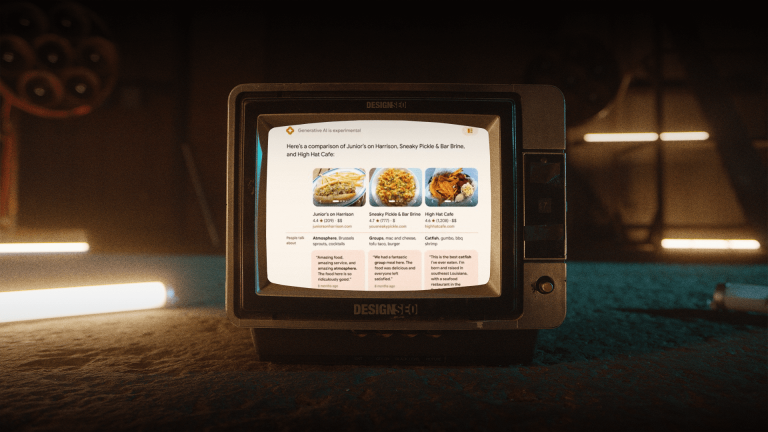
Review note, November 2026: this article retains its original publication date of May 12, 2023, and its archival images. The text was revised to correct the confusion between Bard and Google’s generative search. Historical screenshots do not necessarily describe the interfaces available today.
Google Bard was the conversational assistant that was renamed Gemini on February 8, 2024. SGE, the generative search experience introduced within Search Labs in May 2023, was a separate initiative. Understanding that difference helps interpret Google’s announcements and make content and SEO decisions without mixing products.
Bard and SGE: distinguishing the assistant from search
The following archival screenshot shows a local restaurant comparison in the experimental SGE experience. It belongs to Google Search, not the Bard interface. It is retained to document the search developments introduced in 2023.

Bard let people converse with an artificial intelligence tool to explore ideas, write, and address queries. Google announced the name change to Gemini to connect that experience with its model family. The February 2024 announcement also introduced new access options, including a mobile app. These are historical milestones, not a description of current plans, prices, or features.
A conversational assistant and a search engine may share technologies, but they fulfill different functions. For a business, using Gemini to support writing is not equivalent to gaining visibility in Google Search. Nor is there a Bard results page that should be treated as though it were the traditional search engine.

How experimental SGE search worked
In May 2023, Google introduced SGE as a Search Labs experiment. Its announcement described generated answers within search, links for further exploration, and follow-up questions that retained context. Those characteristics belonged to the Search experience and did not justify attributing the entire new interface to Bard.
Comparisons with ChatGPT or Bing can help explain conversation in natural language. They do not, by themselves, demonstrate that the products have the same architecture, sources, or selection rules. Nor is there a basis for presenting Bard simply as an evolution of the MUM model based on an interface’s appearance.

Product searches and purchase decisions
The SGE announcement also described a shopping experience supported by Shopping Graph, with product information and elements for comparing products. This was a Google Search proposal in 2023, not a universal Bard feature. The size of a catalog announced at the time should also not become a current figure without a new check.

For a retailer, the practical lesson is to review which information enables decisions: features, compatibility, availability, delivery terms, and returns. Those data must remain consistent across the site’s pages and the commercial channels it uses. A generic description leaves questions open that a person needs to resolve before buying.
For a review or affiliate site, it is worth providing comparison criteria, explaining how each alternative was evaluated, and distinguishing firsthand experience from manufacturer information. The presence of AI-powered answers does not support concluding that all these sites will lose traffic or that a listing will automatically appear as a recommendation.

Limitations and verification of AI-powered answers
Generated answers can contain errors or present information out of context. Before using a recommendation, review the original source, its date, and whether it really addresses your case. In health, finance, or legal matters, an automatic answer does not replace a professional assessment when appropriate.
It is incorrect to claim that Google will never show AI-powered answers for health or finance topics. Restrictions, availability, and behavior depend on the product and may change. The access limitations of a 2023 experiment also do not describe the current availability of Gemini or Search features.

From SGE to AI Overviews and other Google developments
In May 2024, Google announced AI Overviews in Search. To understand that evolution, it is useful to separate three names: Bard was the assistant renamed Gemini; SGE was the experimental search experience; AI Overviews identifies AI-generated summaries within the search engine. This chronology does not imply that every query displays such an answer.
The original coverage also brought together developments involving user perspectives, image context, video translation, and tools for taking information into spreadsheets. They should not be presented as a package of Bard features, nor should every experiment be assumed to remain available. To evaluate a specific tool, consult its current documentation and check whether it is available for your account and country.


What to review in a content and SEO strategy
Editorial work still begins with people’s questions. Instead of adding mentions of artificial intelligence to every page, identify what someone needs to know to understand your service, compare alternatives, or request a proposal. Answer with verifiable information and indicate the limits of what you offer.
Explaining the offering and supporting claims
A service page can clarify whom it is for, what the work includes, and what is excluded. An informational article can distinguish facts, interpretations, and recommendations. Cases should describe their context and use authorized, verifiable results. Adding a source at the end does not correct an exaggerated claim in the title.
Maintaining a navigable structure
Use headings that describe each section, readable paragraphs, and links that allow relevant information to be explored further. Check that important pages are accessible and that their main content does not depend on a hard-to-find interaction. There is no universal answer length or special markup that guarantees citations in AI-powered results.
Measure before attributing changes to AI
Separate visibility, visits, and commercial results. A change in traffic requires reviewing queries, pages, comparable periods, and other site changes. Receiving a sales inquiry does not, by itself, identify which generative answer may have influenced that person. Avoid presenting correlations as proof of a single cause.
How to address these changes with Agencia Cero
If your website no longer explains your offering well, the strategic web design service lets you work on its structure, content, and navigation, with scope and measurement agreed for the project. It is a concrete way to improve the information people find without promising rankings or appearances in AI-powered answers.
The priority is for every page to have a clear function and information the team can maintain. Before adopting a new tool, define what problem it will solve, who will review its results, and how you will check whether it contributes to the work. To discuss that context, you can contact Agencia Cero.
Sources and historical context
Announcement of the change from Bard to Gemini, February 8, 2024; introduction of SGE, May 10, 2023; announcement of AI Overviews, May 2024; and Google’s guidance on optimizing for its AI features.



