
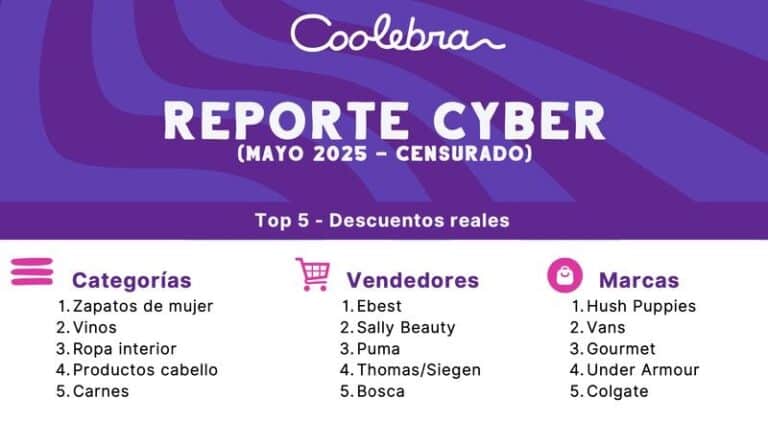
To evaluate CyberDay 2025 discounts, compare the final price with its history and review the purchase terms. The analysis released by Coolebra about the June event raised questions about certain promotional reference prices. Its observations should be read as findings attributed to that platform, not as a ruling establishing violations by each seller.
This article preserves the context of CyberDay held in Chile from June 2 to 4, 2025. It examines what Coolebra communicated, the limitations of that public information, and what consumers and brands can review before trusting a discount percentage.
What Coolebra reported about CyberDay in June 2025
In his post about the analysis results, Juan Paulo Alcalde, CEO of Coolebra, stated that they reviewed prices for three million products and identified more than 142,000 with what he described as inflated prices, associated with more than 1,500 sellers. He attributed 91% of the cases flagged to changes before the event and 9% to changes during it. He indicated differences of 23.6 and 2.1 percentage points in the discounts, respectively. He also reported genuine offers.
What the public source supports and what remains unknown
The consulted post is a summary of the analysis, not a downloadable database containing all observations and classification rules. Reproducing it would require knowing the comparison dates, store coverage, treatment of product variants, and payment methods considered. The figures therefore do not support claiming that all businesses at the event acted the same way or independently identifying a seller as an offender.
An observed price change, a consumer complaint, and an established violation are different categories. The information allows questions to be raised about promotional clarity, but it does not replace an investigation of each case. Nor should an increase in percentage points of the advertised discount be confused with an equivalent percentage increase in the price paid.
How to check whether an offer represents savings
The visible percentage needs an understandable reference. A crossed-out price may indicate a list price, while the history shows how much the product was offered for at other times. Comparing both helps evaluate the offer, provided it is the same model, seller, and payment condition.
A practical check before buying
- Identify the product’s exact model, size, version, and seller.
- Review its available history and observation dates. An incomplete record cannot reconstruct the price’s entire behavior.
- Compare the total payable at other stores, including shipping and payment-method terms.
- Check stock, delivery timeframe, promotional restrictions, and return conditions.
- Keep the offer, its date, and the receipt if you need to inquire about or complain about a difference.
Comparison tools can help, but their records do not necessarily cover every store, variant, or promotion. Other buyers’ comments provide context about individual experiences; they do not, by themselves, prove a general practice. When a discrepancy arises, document the specific case before drawing conclusions about the entire brand.
Urgency, reference prices, and promotional language
A campaign may highlight a closing date, available units, or a specific benefit. Those devices must correspond to verifiable conditions. There is no basis for claiming that a promotional word overrides everyone’s critical thinking or that a technique always produces the same reaction.
Scarcity and fear of missing out
Messages such as “only a few units left” or “today only” can influence how quickly a decision is made. Before using them, the team must check that they reflect actual inventory or validity periods. If a countdown resets without explanation or the condition does not match the listing, it is worth requesting clarification and retaining evidence, without automatically assuming fraudulent intent.
The price anchor and words that need support
The reference value influences how the promotional price is interpreted. That is why it must be explained and internal traceability maintained. “Guaranteed,” “exclusive,” or “maximum savings” need a description of the benefit and its limitations. A guarantee is communicated with its terms; exclusivity, with a specific reason that can be verified.
What a brand can do to communicate transparently
The campaign must match the product listing, cart, and subsequent service. Branding and identity work helps organize the message, but pricing and fulfillment conditions also require commercial and operational coordination.
Checks before and during a promotion
- Document the reference price, final price, validity period, and person responsible for each change.
- Check that the ad and page show the same condition.
- Explain whether the discount depends on a card, coupon, membership, or combination of products.
- Test the journey through payment and identify differences in shipping or availability.
- Define who corrects a discrepancy and how the affected buyer is informed.
The digital advertising service can adapt messages and variants to agreed audiences. That capability does not, by itself, validate an offer: supporting evidence for the price must come from commercial records. The strategic website must make the terms visible at the decision point.
SEO and content that help verify a purchase
Complete listings, buying guides, and explanations of a commercial policy answer specific questions. Organize information by product and condition, with clear titles, direct answers, and dates when relevant. Inbound marketing can connect those answers with inquiries and follow-up, without promising search engine positions or citations in artificial intelligence answers.
What to measure after CyberDay
Review sales, margin, cancellations, returns, and repeat purchases. You can observe cohorts at 60 and 90 days if those timeframes make sense for your category. Comparing exposed and unexposed buyers provides context but does not, by itself, demonstrate incrementality: the groups may differ from the outset. Estimating causality requires an appropriate evaluation design.
The digital analytics service allows sources and indicators to be agreed. Distinguish a conversion recorded by the platform from a confirmed sale, and a complaint from its resolution. A decline in margin is also insufficient to attribute reputational damage without additional evidence.
What to ask your agency before the next event
Request a plan that connects offering, messages, destination, and measurement. Ask how terms will be reviewed, who will approve changes, and what will happen if a difference appears between the ad and cart. Marketing automation can organize notices and follow-up within the agreed scope, without replacing commercial oversight.
At Agencia Cero, we work on content, campaigns, and measurement according to the project’s needs. If you want to organize your promotional communication, let’s discuss the context and next steps.



