
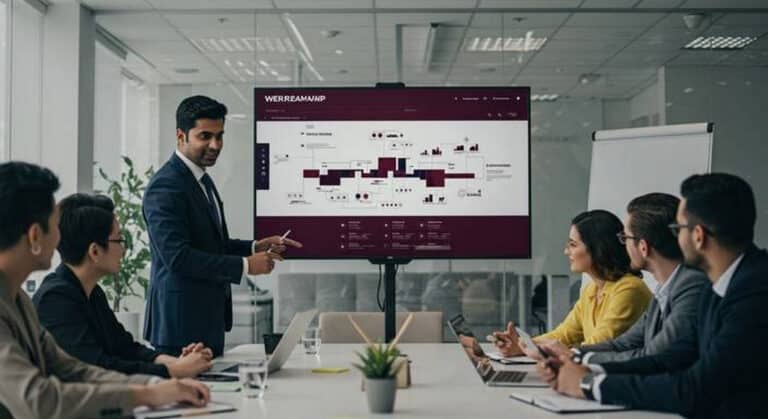
The digital sales funnel organizes the journey from discovering a need to purchase and loyalty. It adapts content, follow-up and measurement to each stage: TOFU to attract, MOFU to help evaluate and BOFU to facilitate the decision. The actual journey is not always linear; review where opportunities stop before investing more.
What is a digital sales funnel?
A digital sales funnel is the process taking a person from discovering a problem to choosing your solution and staying. It is called a funnel because it starts with a broad audience and narrows toward those with genuine intent and fit. It is an operational map for deciding what to show, where and with what evidence.
From visitor to customer: the journey the funnel organizes
The funnel organizes the customer journey so it does not depend on manual effort or memory. At the top it attracts, in the middle it educates, at the bottom it persuades and closes, and afterward it builds loyalty to maximize value over time. When that journey is designed, the experience feels smooth and customers feel they are progressing at their own pace.
This sequence is designed through strategic web design, where each section answers a journey question: what you do, for whom, why to believe and what to do now. It connects with inbound marketing, where content is published to answer a real question at each stage. Without that organization, marketing delivers loose pieces customers must assemble themselves, and few do.
Why measure progress rather than just clicks?
Without a funnel, every nonconverting visit is lost and every unready lead goes cold. Cost per customer rises even if cost per click falls because you pay for attention that does not progress. Measuring the funnel reveals these losses; correcting them requires tests and does not ensure a lower cost.
Direct benefit: personalization and measurement by stage
The funnel improves conversion by personalizing messages, reduces loss and enables measuring every step for real-time optimization. By segmenting by stage, you give different evidence to someone discovering than to someone comparing, and avoid pushing someone who still needs understanding. This personalization increases satisfaction and loyalty because customers feel guided without being forced.
This stage-based measurement is organized with strategic data, distinguishing activity from business and prioritizing cost per opportunity and progression rate. It is verified through intelligent automation, moving opportunities to the next step without someone having to remember. When data trigger action, the funnel turns measurement into learning.
What should you personalize first?
Personalize according to the stage’s main objection. In discovery the objection is relevance, in consideration it is risk, and in decision it is proof and price. Compare responses to each message before concluding which works best.
Funnel stages: discovery, evaluation, decision and loyalty
A practical way to organize the journey is to distinguish discovery, evaluation, decision and loyalty. TOFU, MOFU and BOFU describe the top, middle and bottom of the funnel; AIDA is another model using attention, interest, desire and action. These are guiding frameworks, not mandatory stages everyone follows identically.
TOFU: discovery, where customers name their problem
In discovery, users become aware of a problem. Your objective is to attract qualified traffic with content naming their pain in their own words. For example, a management software company can explain how to organize sales follow-up before presenting its product.
That attraction pays off when it leads to an asset capturing contacts without asking too much: a checklist, short guide or honest comparison. That asset should feed strategic email to nurture without chasing. The priority metric is capture rate by intent.
TOFU content that leaves a traceable record
Useful TOFU content leaves a traceable source and a clear next step. If it leaves neither traceable contact nor progress, it is reach without pipeline.
MOFU: interest, where customers compare solutions
In interest, users already recognize the problem and seek solutions. You should educate and generate interest with evidence and criteria. Continuing the software example, a guide comparing features and integrations helps evaluate fit with the team.
This education is orchestrated through inbound marketing and supported by social video content when the explanation is visual. The key is answering what your solution does differently and what it does not do, so customers self-select and your team does not pursue poor fits.
A sign that MOFU is progressing
If a contact returns to a pricing page or contextual case after consuming MOFU content, they are progressing. If they only open and do not return, proof is missing or the next step is unclear.
BOFU: desire, where proof supports the decision
In desire, users consider buying. Your mission is to generate desire with risk-reducing proof: a clear guarantee, a case with results, a brief demonstration or a discount that does not erode value. In the software example, a demonstration of the actual process and clear contracting terms help evaluate the decision without relying on discounts.
This proof is presented through strategic web design and accelerated with AI-powered DCE dynamic advertising when validating messages with audiences that have already shown intent. Desire without proof is fragile impulse; with proof, it is a decision with less regret.
How can you show evidence that helps people decide?
Show before and after with context, time, cost and trade-offs. Specific evidence reduces risk objections more than a generic promise.
Action and loyalty: where value is gained over time
In action, users buy, but the funnel does not end. Loyalty maximizes value over time through referrals, repeat purchases and expansion. In the software example, onboarding and help using relevant features form part of the post-purchase experience.
This loyalty is sustained through strategic email and intelligent automation, maintaining the conversation according to behavior. Measuring repeat purchases and referrals prevents the funnel from being only acquisition and turns it into business.
Loyalty metrics managers actually use
90-day repeat-purchase rate, average order value by cohort and reason for recommendation. These three tell you whether the funnel creates customers or just transactions.
Benefits the funnel makes visible in your operation
Implementing a funnel brings concrete advantages when progress is measured by stage.
Segmentation that increases conversion and optimizes returns
Segmenting and adapting messages lets you test conversion and return improvements by channel. The funnel lets you move budget from stages that do not progress to ones that do, rather than asking for more budget to compensate for leakage.
That move is decided with strategic data and executed with intelligent automation, reallocating without manual friction. To organize the stack without overbuying, review digital marketing tools for sales managers in 2025, distinguishing tools by pipeline impact.
A simple budget rule by stage
If a stage falls below the defined threshold, review traffic quality, data volume, decision time and attribution before reallocating budget. No investment percentage suits every funnel.
A smooth experience that increases satisfaction and loyalty
Relevant content by stage creates a smooth experience that increases satisfaction. Customers feel guided. That guidance reduces effort and increases the likelihood of return and recommendation, where the funnel pays off most.
This smoothness is maintained through strategic UX/UI, where each state of the flow confirms the right path, and branding, sustaining repetition of the central idea so every piece adds to recognition rather than restarting the relationship.
Details that break the flow in seconds
A form that does not confirm submission, a promise the landing page does not uphold or a hard-to-find number. Correct these three before producing new content.
Mistakes that break the funnel even when tactics are good
A strong funnel fails through foundational errors no campaign can compensate for.
Attracting without capturing and nurturing without segmenting
The first mistake is generating visits that are not captured and leads that are not nurtured. Without traceable capture, traffic leaves no record and paid media pays for the same person each time. Without segmented nurturing, leads cool and the team pursues them cold.
Correct this with progressive capture asking only for what is needed and objection-based sequences delivering the right piece according to behavior: the logic of inbound marketing and strategic email. To avoid repeating content that does not advance, base your calendar on digital marketing strategies: less content, more sales, where producing less with intent yields more.
A capture checklist that does not break the funnel
One essential field, clear confirmation and a visible next step. Asking for a phone number without explaining why breaks trust before you start.
One message for different stages and a metric that does not guide decisions
The second mistake is using the same message for discovery and comparison, and measuring reach instead of progress. One message generates indifference, while activity metrics hide stagnation.
Correct this by adapting proof by stage and measuring progression rate and cost per qualified opportunity, an approach organized by AI-powered DCE dynamic advertising when validating messages by audience. If you need to accelerate thoughtfully, compare with 8 digital marketing tips to accelerate sales growth, where remarketing and copy push forward without burning budget, and 8 free resources to avoid buying tools before validating the flow.
A sign your messaging is stage-based
If each stage has a different headline answering its objection and different proof reducing its risk, your messaging is stage-based. If every page says the same thing with a different design, it is not.
How can you start improving your sales funnel?
A funnel converts when it has an owner, a hypothesis and a short review cycle.
Assign an owner per stage, define a progression metric and threshold for scaling or correcting, and execute in 14-day cycles. Map existing content by stage, pause what has no hypothesis and produce one piece for each missing stage, with a page upholding the promise and automation moving things without friction. This cadence also supports improving sales with digital marketing: 9 tips, where each tip becomes an action with a metric.
If you want to design it with an outside perspective and no promises of magical growth, let’s talk through contact. We start with your actual funnel, review friction by stage and connect tools your team will use, with the Agencia Cero standard so the system converts with measurable results.



