
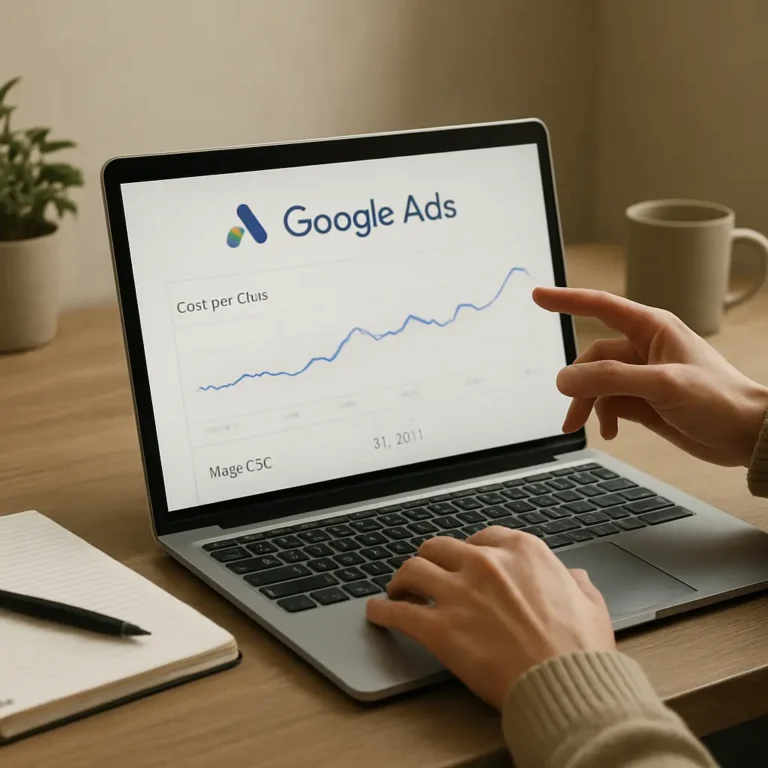
Google Ads pricing depends on the auction, competition, targeting, and the quality of the ad and landing page. There is no single rate: the budget needs to account for advertising spend, management, and measurement, as well as cost per click and cost per lead.
What does Google Ads pricing include beyond the click?
When a company asks how much it costs to advertise on Google, it almost always expects something resembling a catalog price. However, Google Ads pricing follows a different logic. Instead of buying space at a fixed price, advertisers participate in a dynamic auction influenced by competition, search intent, ad quality, landing page experience, and the likelihood of generating interaction. That is why two businesses selling very similar services can achieve completely different results with similar budgets.
The most common mistake is associating cost exclusively with the click. Clicks matter, but they do not explain on their own whether the investment makes sense. A campaign can have a low cost per click and still be inefficient if it attracts poorly qualified users, while another with more expensive clicks can be profitable if it converts frequently and has a high average sale value. In practice, the real price is measured not only by what Google charges, but by what each visit generates afterward.
That distinction changes the entire conversation. A private clinic, a niche ecommerce business, and a tax consultancy should not analyze Google Ads pricing in the same way, because the value of each potential customer differs. If a company earns hundreds of euros per conversion, it can tolerate a much higher initial cost. If the product margin is narrow, any deviation in acquisition cost can make the campaign unviable within days.
How is Google Ads pricing determined?
The Google Ads system relies on auctions that take place in fractions of a second whenever a user searches or browses advertising placements where ads can appear. Although many people imagine that the highest payer simply wins, the platform is not that straightforward. Google considers both the bid and relevance. This means that the final Google Ads price depends on a balance between money and quality.
One of the most important factors is keyword competition. Appearing in searches related to insurance, lawyers, or medical treatments does not cost the same as appearing for informational terms with lower commercial value. The greater a search’s economic potential, the more companies will want to bid on it and the more pressure there will be on the price. In some industries, a single visit can cost several euros or even tens of euros.
Ad quality and landing page experience matter, but they should be distinguished from the Quality Score shown in the account. Google explains that Quality Score is a diagnostic tool, not an input used directly in the auction. It helps assess relevance, expected CTR, and landing page experience; increasing that score does not guarantee a position or a particular cost per click.
Context matters too. Geographic location, device, time of day, seasonality, and performance history change auction behavior. A mobile-targeted campaign in a large city during business hours may cost more than the same campaign shown in less competitive areas or during quieter periods. Prices are not identical throughout the year, either. During periods of high demand, such as seasonal sales campaigns or industry peaks, pressure on bids tends to increase.
How does the cost of Google Ads vary by business?
Giving an exact figure would be misleading, but it is possible to discuss indicative ranges. For local businesses facing moderate competition, cost per click can be relatively affordable, particularly when targeting searches with very specific intent and a limited geographic reach. A repair service in a midsize city, for example, may find reasonable opportunities if it targets carefully and avoids competing for overly generic terms.
By contrast, sectors such as law, finance, education, and healthcare tend to have higher Google Ads pricing, because each customer’s potential value justifies aggressive bids. A law firm specializing in inheritance, a financing company, or an aesthetics clinic can absorb expensive clicks if the return per conversion more than compensates. In ecommerce, the situation varies considerably according to margin, category competition, and brand strength. Highly comparable products with many sellers usually require very precise optimization to avoid eroding profitability.
In lead generation campaigns, it is more useful to look at cost per lead than cost per click. In a hypothetical example, if a company pays 5 euros per click and converts one in every ten visits, its cost per lead would be around 50 euros before considering how many contacts become customers. If one in four leads results in a sale and the margin per customer is 400 euros, there would be room to cover acquisition and other costs, but fees, taxes, and operating expenses would still need reviewing. If the margin is 60 euros, the model is no longer sustainable. That is why pricing analysis should always connect investment with the income statement rather than an isolated metric.
How do you calculate a monthly Google Ads budget?
Many companies want to know how much to invest per month before they have even defined their goals. That investment should be based not on intuition, but on a combination of demand volume, estimated cost, and conversion capacity. A budget that is too low can leave the campaign without enough data to learn, while a high but poorly structured budget can accelerate losses. The optimal budget is not the highest possible one, but the one that enables controlled testing of hypotheses.
A local small or midsize business can start with a moderate investment to capture high-intent searches in its area. What matters is reaching enough scale to generate clicks, conversions, and useful patterns. If the daily budget is so small that it barely generates impressions, any analysis will be unstable. Conversely, a business with strong margins and broad demand can scale quickly, provided it measures conversions properly and knows its target acquisition cost.
Monthly Google Ads pricing is not limited to the advertising balance. It should include management costs, ad creation, landing page optimization, and analytics tracking. An advertiser may believe the amount invested is under control, but failing to account for setup and ongoing improvement means underestimating the channel’s true cost. In competitive environments, leaving a campaign without frequent optimization is often more expensive than investing in rigorous management from the outset.
What increases Google Ads costs, and how can you optimize them?
Some campaigns are expensive from the start because of poor structure. Overly broad targeting, ambiguous keywords, or generic ad copy attracts less qualified traffic and reduces relevance. This worsens performance and, over time, can increase the cost required to remain competitive. External competition is not always the problem; sometimes advertisers pay more because they fail to adapt their message to search intent.
One of the most effective ways to keep Google Ads pricing under control is to focus on specific searches. Bidding on a general term is not the same as bidding on a query with clear intent to hire or buy. More specific keywords usually have lower volume, but they may also offer a higher conversion rate. This precision improves efficiency and reduces wasted budget.
Landing page quality also plays a decisive role. If a user clicks and arrives on a slow, confusing page that does not align with the ad, the probability of conversion falls. Google detects part of that experience and incorporates it into its assessment. Improving speed, content clarity, the value proposition, and usability can have a double effect: increasing conversions and helping reduce cost per click in certain auctions.
Bidding strategy is another key factor. Automation does not mean giving up control, but activating smart strategies without enough data is not advisable either. Choosing between maximizing clicks, maximizing conversions, or using cost-per-acquisition targets requires understanding the account’s stage of development. A business with no history may need to collect signals before expecting algorithmic efficiency. Forcing an automated system to work without a statistical basis can produce unstable decisions and make results more expensive.
Common mistakes when evaluating Google Ads pricing
One of the most frequent mistakes is comparing campaigns across companies without context. Hearing that another company pays little per click tells you almost nothing if you do not know its industry, geography, brand strength, conversion rate, and average transaction value. The same cost can be excellent for one business and ruinous for another. The useful benchmark is not what a neighboring business pays, but what allows your own model to remain profitable.
Another frequent mistake is obsessing over the highest ad position. Always appearing at the top may seem desirable, but it does not always maximize profit. Sometimes a slightly lower position delivers sufficiently qualified clicks at a more reasonable cost. Competing for absolute visibility without analyzing returns can send Google Ads pricing soaring without improving actual results.
Measuring too soon is another mistake. In new accounts, initial data can be volatile. Drawing drastic conclusions from a small number of conversions leads to premature pauses or constant changes that prevent the system from learning. This does not mean keeping poor campaigns running out of habit, but distinguishing between a bad strategy and an early learning phase. Useful patience is thoughtful analysis, not passivity.
An additional problem arises when irrelevant traffic is not filtered out. Without appropriate match types, exclusions, and a sound campaign architecture, ads can appear for searches that do not serve the commercial goal. This waste not only consumes budget; it also distorts metrics and makes it harder to understand the true cost of attracting valuable potential customers.
How do you calculate whether the price is worthwhile for you?
The most sensible way to assess Google Ads pricing is to start with the economic value of a conversion. If you know your average margin, close rate, and operational capacity, you can estimate a target acquisition cost. From there, cost per click stops being an abstract number and becomes a manageable variable. In a second hypothetical example, if a sale delivers a margin of 300 euros and you can afford up to 100 euros per acquisition, you already have a benchmark for judging whether a campaign is within range.
Next, it helps to examine the full journey. Not all conversions have the same value, and not all happen immediately. In many services, the first click starts a chain that ends days or weeks later. Measuring only direct, immediate sales undervalues the channel’s impact. That is why properly configured attribution and clear tracking of forms, calls, or purchases are essential to avoid misinterpreting the price.
Seasonality and account maturity matter too. In the initial stages, performance may be less stable until enough information has been collected. Over time, a well-managed account tends to become more efficient thanks to accumulated data, audience optimization, more precise ads, and better landing pages. This means the price is not a static snapshot, but a variable that can move in your favor or against you depending on management quality.
When is a high price reasonable, and when is it a warning sign?
A high cost is not necessarily a problem if it is backed by value. There are industries in which paying a lot per click makes perfect sense because the potential revenue per customer is substantial. The real problem arises when the price increases without a corresponding improvement in traffic quality or conversion rate. If a campaign becomes more expensive while its results weaken, it is worth reviewing targeting, messaging, bids, and the post-click experience.
One common warning sign is excessive dependence on generic terms. Another is a sustained decline in the conversion rate despite maintaining traffic volume. An increase in spending accompanied by irrelevant queries, low-quality form submissions, or calls without real purchase intent also deserves attention. In these cases, the problem is not always the market; it often lies in the alignment between ad, keyword, and page.
By contrast, some accounts appear expensive at first glance but are exceptionally well structured. They pay high click costs, yes, but convert reliably, filter out useless traffic, and make every euro invested profitable. This is where the difference between price and effective cost becomes clear. The former is what you pay to get in; the latter is what it actually costs to generate business. In Google Ads, that gap can be far greater than an isolated figure in the dashboard suggests.
A telling fact is that, in highly competitive markets, small improvements in relevance and conversion can have a greater impact on profitability than a direct reduction in click cost, because optimizing Google Ads pricing is not only about paying less, but about making every relevant search worth more than the last.
To turn your budget into a testing plan, our digital advertising service helps you work on objectives, messaging, and results tracking. Before hiring an agency, agree separately on media investment, fees, production, and measurement, with a clear spending limit and review criteria.



