
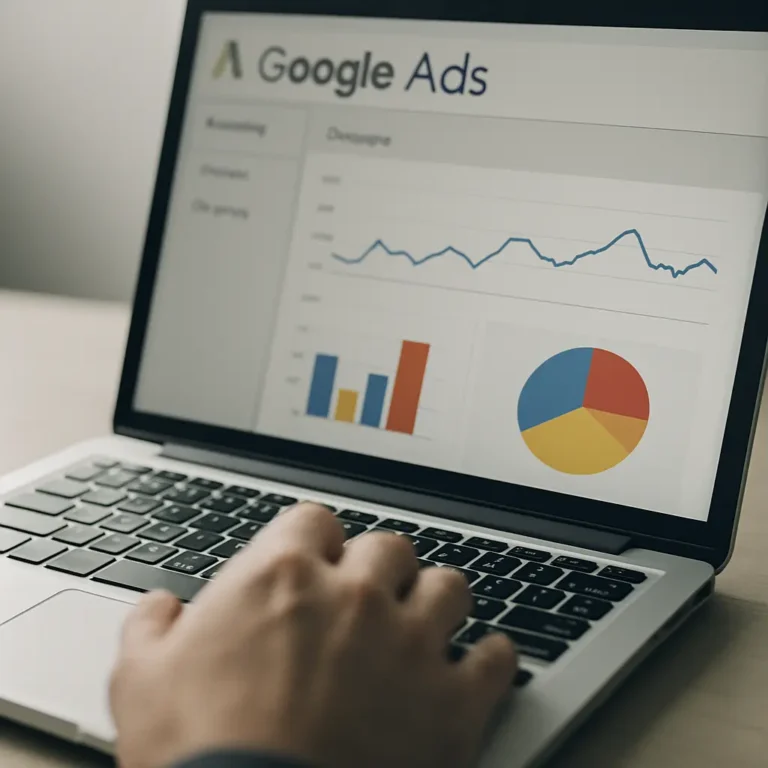
Marketing with Google Ads uses advertising campaigns to reach people who are searching for or may be interested in an offer. A strategy should define objectives, audiences, budget and conversions before assessing results. Clicks are a signal of traffic, but sales, qualified contacts and margin make it possible to evaluate its contribution to the business.
Marketing with Google Ads penalizes improvisation: many companies believe that investing is enough to generate sales, but in reality they are paying for poorly measured mistakes.
That is the uncomfortable truth many businesses discover late. Google Ads rewards advertisers who better understand search intent, ad relevance and the post-click experience. Two companies in the same industry can bid on the same keyword and achieve opposite results. One ends up with forms, calls and sales; the other simply accumulates expensive clicks, inflated metrics and a false sense of visibility. The difference almost never lies in the platform alone, but in the strategy, campaign structure and ability to interpret data without self-deception.
What does marketing with Google Ads really mean when approached thoughtfully?
Reducing Google Ads to “ads on the search engine” is a dangerous oversimplification. In practical terms, it is an acquisition system based on intent, audiences, automation and measurement. Its real value emerges when you understand that not all campaigns pursue the same goal. Some seek existing demand, as happens on the search network when a user types “employment lawyer in Santiago” or “ERP software for SMEs.” Others focus on brand recall, consideration or re-engaging users who have already visited a website but have not yet made a decision. That is why discussing performance without distinguishing objectives leads to mistaken comparisons and hasty decisions.
Well-planned marketing with Google Ads starts with a question that is far more strategic than technical: what kind of customer do you want to attract, and at what point in their decision? If the business sells a high-ticket service, the click is usually just the start of the journey. In those cases, measuring only superficial conversions, such as a page visit or a long time on site, distorts the analysis. What matters is connecting campaigns with business outcomes: real opportunities, qualified sales, average value per customer, repeat business and ultimate profitability.
Search intent is worth more than volume
One of the most common mistakes is chasing high-volume keywords simply because they look attractive. However, a broad term is rarely the most profitable. Someone searching for “sneakers” may be comparing styles, prices or brands, or simply browsing. Someone searching for “men’s overpronation running shoes size 43” shows much more specific intent that is closer to a purchase. That difference completely changes the value of the visit.
In Google Ads, keywords trigger ads and signal the user’s stage of thinking. The closer that signal is to a specific need, the more sense it makes to pay for it. This explains why low-traffic campaigns often outperform campaigns with thousands of impressions. The inexperienced advertiser celebrates volume; the effective advertiser looks at quality, cost per acquisition and value generated.
It is also worth understanding that intent can be found in context, beyond the exact phrase. A search such as “dental implant prices” reveals a different concern from “best dental clinic in Valparaíso.” The first focuses on cost and comparison; the second on trust and choosing a provider. Both can be useful, but they require different messages, extensions and landing pages. When the same ad is used for everything, performance drops because users feel the answer does not fit what they have just searched for.
Campaign structure: where much of performance is decided
A disorganized account makes analysis difficult and the system more expensive. Grouping too many disparate keywords into a single ad group prevents precise messaging and makes it harder for Google to understand relevance. This can indicate problems with relevance and the landing page experience. It is worth reviewing Quality Score as a diagnostic tool, without interpreting it as a guarantee of cost or position. The bid alone does not explain a campaign’s performance.
A solid structure usually separates campaigns by business line, geography, objective or type of intent. Within that framework, each ad group needs enough semantic consistency to connect the search, ad copy and landing page. If a clinic offers orthodontics, implants and cosmetic dentistry, mixing everything in the same group creates friction. Separating services, by contrast, allows headlines, benefits and trust signals to be tailored to the user’s specific need.
Structure also affects how data is interpreted. If everything is mixed together, it is impossible to identify which service converts best, which geographical area consumes budget without a return or which device needs adjustments. Good organization is a prerequisite for intelligent decisions. In competitive environments, that difference matters more than many people realize.
The ad filters, qualifies and guides users toward a sale
There is a temptation to write generic ads to “avoid missing searches,” but that logic tends to attract unhelpful clicks. An effective ad does not try to appeal to everyone. Its job is to attract people who are a good fit and discourage those who are not. That requires a clear message about the offer, value proposition and expectations. If a service starts at a certain price level, works only with businesses, operates in a particular area or stands out through a distinctive advantage, it is worth stating that clearly.
The most effective copy tends to answer three questions concisely: what do you offer, why should I care and why should I trust you now? In a commercial search, clarity beats empty creativity. Saying “Accounting software for SMEs with invoicing and bank reconciliation” offers much better guidance than an ambiguous headline about innovation or growth. The promise must be specific and credible. When an ad exaggerates or promises too much, it may increase initial clicks but worsen subsequent conversion.
Extensions also play a quiet but decisive role. They provide additional context, occupy more visual space and allow attributes such as location, phone number, service categories or internal links to stand out. Used well, they improve the likelihood of receiving more informed clicks. Used poorly, they merely decorate a weak proposition.
The landing page is often the real bottleneck
Many campaigns fail for a reason unrelated to bidding or keywords: the page users reach does not deliver what the ad promised. This break between expectation and experience is one of the costliest problems in marketing with Google Ads. Someone searches for a specific solution, clicks with a certain sense of urgency and lands on a slow, confusing or excessively corporate page. Within seconds, they decide to leave.
A capable landing page must maintain continuity in the message. If the ad talks about a specific service, the page should open with that same service, not a generic company homepage. If users are looking for speed, a quote or a demonstration, that option should be visible without requiring too much interpretation. Fewer distractions, more focus. Less corporate rhetoric, more evidence that the visitor’s problem is understood.
Loading speed, mobile design and form clarity directly affect the conversion rate. A long form can make sense for filtering opportunities in complex services, but only if every field adds real value. In many cases, asking for too much information at the outset reduces the number of contacts without improving their quality. Optimization therefore means removing unnecessary friction and building trust with concrete evidence: testimonials, case studies, experience, guarantees, geographical coverage or transparent information.
Measurement: poor setup becomes misleading
An account can display apparently healthy metrics and still destroy profitability. High click counts, growing impressions and an acceptable cost per conversion mean little if measurement is poorly defined. One of the most frequent mistakes is counting events with little commercial value as conversions, such as visits to a contact page, superficial clicks or interactions without real intent. This feeds weak signals to algorithms and steers automation toward irrelevant objectives.
Good measurement means distinguishing between useful micro-conversions and primary outcomes. A call of a certain duration, a validated form, a booking, a sale or a qualified opportunity carry very different weights. When conversions are imported from a CRM or actual sales data is connected, optimization becomes much more reliable. It is no coincidence that more mature accounts focus less on cost per click and more on indicators such as return on ad spend, value per conversion and margin contribution.
Attribution also matters. Not all users convert on the first visit, and not all clicks play the same role in the decision. For more complex products or services, the journey may include several searches, repeat visits and comparisons. Looking only at the last click hides part of the story and may lead to cutting campaigns that do contribute to the outcome, even if they do not close the sale immediately.
Automation and artificial intelligence: useful, but not magic
Google has strongly promoted automated campaigns, Smart Bidding and responsive ads. Implemented well, these tools can improve efficiency and scale. The problem arises when they are treated as substitutes for strategy. Automation learns from past signals, but it does not fix a poorly positioned offer, confusing targeting or faulty measurement. If the system is fed poor data, optimization will be poor, however sophisticated the algorithm may appear.
Automated bidding tends to work better when there is already a reasonable volume of reliable conversions and a clear structure. In new accounts or those with limited data, it is worth watching the learning phase especially closely and avoiding constant, abrupt changes. Many advertisers sabotage their campaigns by changing budgets, targeting, ads and objectives all at once, preventing the system from accumulating consistent signals. Patience here is methodological discipline.
Something similar happens with responsive ads. They offer flexibility to combine headlines and descriptions, but that flexibility should not turn into contradictory messaging. If benefits, tones and propositions are mixed without consistency, the result may be technically sound but weak in its persuasiveness. Automation amplifies what already exists; it does not invent a strong value proposition.
Budget, competition and profitability: three variables that must not be confused
It is common to hear that a campaign “doesn’t work” when the actual problem is something else: an insufficient budget for a highly competitive category, unrealistic profitability expectations or the business’s inability to convert the demand captured. Google Ads does not fix structural shortcomings in sales. If the offer is less attractive than competitors’ offers, customer service is slow or the sales process leaks, advertising will only make the problem more visible.
That is why profitability must be analyzed in context. In sectors such as insurance, legal services, aesthetic healthcare or B2B software, cost per click can be high because the customer’s potential value is also high. Paying more is not necessarily bad if the return justifies it. What is concerning is paying without knowing how much a new customer is worth, how long they stay and what margin they contribute. Without that information, any judgment about budget is incomplete.
Competition is not measured solely by who appears at the top, either. Sometimes a competitor with a seemingly modest ad and an excellent page outperforms better-known brands. Google’s auction considers more factors than the bid alone, and users decide using even tougher criteria: relevance, clarity, trust and ease. On that playing field, a well-focused small business can perform better than another with greater recognition but poorer execution.
Common mistakes that make marketing with Google Ads more expensive
Among the costliest mistakes is leaving irrelevant searches unfiltered through a lack of negative keywords or uncontrolled overly broad matching. This exposes the budget to low-intent queries, ambiguous meanings or users who do not fit the offer. Another typical mistake is launching campaigns without realistic geographical targeting, generating clicks from areas where the company does not operate or cannot serve customers well.
Ignoring behavior by device is also damaging. Some businesses convert better on mobile because of urgency or the ease of calling, while others need desktop because the decision requires more reading or a complex form. Failing to observe these differences leads to inefficient allocation of spend. The same applies to schedules, audiences and messages at each stage of the funnel.
Another delicate issue is evaluating too soon. Some campaigns need to accumulate data before showing their potential, especially if the buying cycle is not immediate. Cutting them out of anxiety prevents learning. At the opposite extreme, keeping clearly unproductive campaigns running out of attachment to an initial idea also destroys performance. Mature management means distinguishing normal variation from a real problem and acting with judgment rather than on impulse.
What does a mature strategy look like in practice?
A solid marketing strategy with Google Ads usually recognizes that each search has a different value, that not all users should receive the same message and that real optimization happens across platforms, data and the business itself. Imagine a company selling clinic management software. It can run search campaigns for high-commercial-intent terms, remarketing campaigns to re-engage visitors who have not converted, and segmented audiences to reach specific decision-makers with messages adapted to their specialty. If it also connects forms to its CRM and ranks opportunities by quality, it can teach the system which profiles ultimately generate contracts and which do not.
That level of maturity changes the conversation. The question shifts from “how many clicks came in” to “which combination of search, message, page and segment produced profitable customers.” When a company reaches that perspective, Google Ads stops being an isolated tactical channel and becomes a measurable source of commercial learning. From there, even campaigns that do not shine immediately can reveal something valuable: price objections, areas with a better response, services with more traction or messages the market understands more quickly.
In fact, one of the less-discussed strengths of marketing with Google Ads is that it works as a real-time laboratory of intent: few tools reveal so starkly what a company promises, what users understand and how much it costs to turn that gap into business.
If you need to review the relationship between investment, messages and results, explore our digital advertising campaign management service. We can discuss the objectives and measurement of your Google Ads campaigns.



