
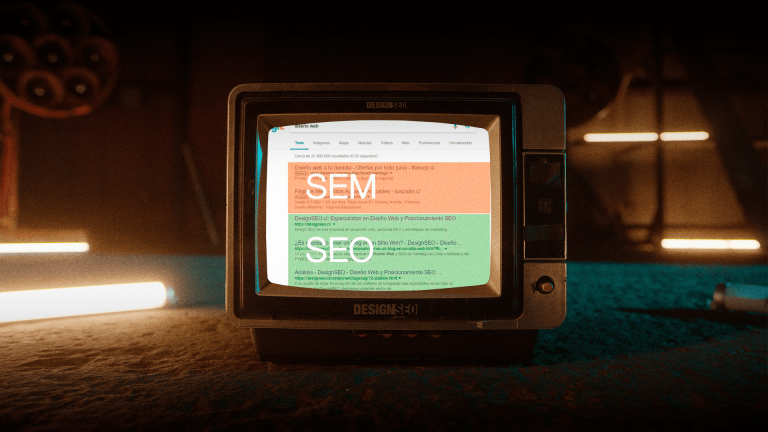
The term SEO, short for Search Engine Optimization, refers to work that improves a site so search engines can discover and interpret its pages and people can find useful answers in organic results. It includes content, structure, links, and technical aspects. It does not mean paying for each click, nor does it guarantee appearing first.
Its history follows the growth of the web: from organizing pages and words to link analysis, language understanding, and answers generated with artificial intelligence. To understand that evolution, it helps to separate three things: the emergence of search engines, changes in their systems, and the practices of website publishers. No single launch marks the beginning of the entire discipline.

This overview explains the main milestones and what you can learn from them when reviewing a website today. The dates indicate documented announcements or changes; they do not imply that each technology suddenly replaced the previous ones.
How the history of SEO began
The need to find information grew alongside the number of resources available on the internet. Publishing a page did not ensure that anyone could locate it. Directories and search engines offered different ways to organize that content, and site owners began paying attention to how their pages were discovered and presented.
SEO did not move from a simple recipe to a more complex one. Over time, search engines incorporated systems that consider content, relationships between pages, and the meaning of queries. Repetition or manipulation tactics coexisted with the work of creating readable, useful, and accessible sites.
For a business, knowing this history helps distinguish a lasting practice from a shortcut associated with a particular era. A website should explain its offer and make it discoverable, but visibility does not replace service quality or guarantee that a visit ends in a sale.
The first search engines and the growth of the web
Even before the web expanded, tools already existed for locating internet resources. McGill University dates the creation of Archie, developed by Alan Emtage, to 1989. It was not a search engine for web pages like today’s engines. In parallel, Tim Berners-Lee proposed the World Wide Web at CERN in 1989; the internet and the web are not synonyms.
During the 1990s, names such as Yahoo!, Lycos, and AltaVista formed part of how people accessed content through directories and search engines. A directory organized by category did not work like a search engine that crawled pages. That difference also changed how a site could be discovered.
The discipline’s history includes publications and professionals who spread practices, but a media outlet’s name should not be presented as if it were a technique equivalent to SEO. Nor is it necessary to attribute the invention of the term to one person to understand its function: helping a site be found and understood in relevant searches.
SEO and SEM do not mean exactly the same thing. SEO refers to organic optimization. SEM, Search Engine Marketing, can be used as a broad concept for marketing in search engines, although commercial usage often refers to ads. PPC describes a pay-per-click model, not a stage that replaced SEO. When hiring a provider, clarify what each term includes.
Early search placed importance on words and signals available in documents. This led to interest in titles, descriptions, and structure. Those elements still help communicate a page’s topic, although they now operate within much broader systems and are not enough on their own to compete.
Excessive keyword repetition was one practice used to try to influence results. Not all site owners worked this way, nor did all search engines function in the same way. Today, filling a page with unhelpful terms can fall under spam policies and make it harder to read.
Google, PageRank, and link analysis
According to Google’s official history, Larry Page and Sergey Brin began collaborating on a search engine called Backrub in 1996; the company was incorporated in 1998. It is important to distinguish the university project from the company’s founding. PageRank incorporated link analysis to estimate the importance of pages. Its operation evolved, and it remains part of Google’s systems, without being reduced to counting backlinks.
To organize the work, it helps to distinguish three groups of practices. They are not inventions that all emerged on one specific date, but useful categories for understanding what is reviewed:
- On-page SEO: content, titles, headings, and internal links that describe and connect pages.
- Off-page SEO: relevant external references and links. Buying links to manipulate rankings is not the same as building a reputation.
- Best practices and manipulative techniques: the labels white hat and black hat usually distinguish between work compatible with search engine policies and tactics aimed at circumventing them.
Blogs and other editorial formats offered spaces for developing guides, opinions, and linkable resources. Publishing more does not mean providing more value: an article needs a purpose, reliable information, and a connection to the audience’s questions. For example, a company can explain how to evaluate a service before presenting its own offer.
Quality, spam, and language understanding: 2010-2019
During the 2010s, Google documented changes addressing quality, spam, and query understanding. These milestones are not a list of buttons that can be activated on a website:
- Panda (2011): aimed at favoring quality, original content. It became part of the core systems in 2015.
- Penguin (2012): developed to combat link spam. It was integrated into the core systems in 2016.
- Hummingbird (2013): a major improvement to search systems applied in August. It was not the sole origin of semantic understanding.
- RankBrain (2015): incorporated deep learning to connect words and concepts, according to Google’s explanation of AI in Search.
The official guide to ranking systems distinguishes current systems from historical ones integrated into others. Every drop should not be interpreted as a “Panda penalty” or a Penguin penalty: data on indexing, queries, pages, and site changes are needed. For related reading, you can review this approach to keywords and people’s needs.
In 2019, Google announced the application of BERT to search to better understand the context of words. The practical lesson is to write explanations that make complete sense: a sequence of isolated terms is no substitute for an answer. There is no tag that “activates BERT” on a site.
SEO today: technical work, content, and new forms of search
Today’s work brings together several areas. Some belong directly to website SEO and others broaden the ways people discover brands and content:
- Technical SEO: access to content, crawling, indexing, and structure. It includes reviewing performance and Core Web Vitals, without confusing a technical score with a ranking guarantee.
- Content: answers that match intent, useful examples, sources, and information maintenance.
- Conversational and voice queries: naturally worded questions. Writing a clear answer makes it easier to understand, but does not ensure that an assistant will select it.
- Discovery on social media: searches within TikTok, Instagram, or LinkedIn have their own formats and systems. They complement a digital presence; they are not the same as optimizing a website for Google.
Visual, conversational, and AI-generated-answer searches broaden the ways people explore information. This calls for reviewing how content is presented and verified, without assuming every query will have the same format or that there is a formula for being cited. Below, we review what AI answers change and which fundamentals remain.
Helpful content and AI answers: from 2022 onward
The helpful content system was announced in 2022 and evolved to become part of the core systems in March 2024. It is useful to consider that continuity instead of treating it as an isolated check that a page passes once and for all.
Google announced the expansion of AI Overviews to users in the United States in May 2024 and introduced AI Mode as a Labs experiment in March 2025. These are rollout milestones, not dates when all countries received the same features. These experiences combine generated answers with links to continue exploring.
Terms such as AEO, answer engine optimization, and GEO, generative engine optimization, are used to discuss visibility in these experiences. They are not certifications and do not replace technical and editorial SEO. For Google’s AI features, the documentation maintains SEO fundamentals and does not require special optimization that ensures inclusion. Publishing clear answers and verifiable sources helps understanding, but does not guarantee AI citations.
What SEO can contribute to a business
SEO can help someone find an explanation, product, or service without the publisher paying for that organic click. That does not make it a free activity: it requires production, review, and technical work. Nor does it always replace advertising. The channel mix depends on demand, goals, budget, and the business’s stage.
Possible benefits and limits worth knowing
- Relevant visibility: the possibility of appearing for queries related to the business, if the pages are eligible and relevant.
- Visits with context: people searching for information related to the offer, without assuming that all of them want to buy.
- An organic channel: a way to be discovered that can complement ads, with maintenance costs and variable results.
- A more understandable website: structure, content, and journeys that help people find information and take action.
- Verifiable information: explaining scope, sources, and experience makes it easier to evaluate the offer, without ensuring authority simply by publishing.
These benefits are possibilities to be measured, not automatic results. Before expanding the effort, define which pages you need, which questions they will answer, and which actions you will observe. Competition, technical condition, the offer, and sales support also influence the outcome.
What to learn from the evolution of SEO
The evolution of SEO shows continuity: making useful information accessible remains important even as systems and the presentation of results change. Understanding the milestones helps review old practices, rather than chase every update name. An audit should connect concrete problems with actions the team can implement and verify.
At Agencia Cero, strategic web design organizes content and navigation, while digital analytics helps review available actions and results. The scope of structure, content, configuration, and measurement is agreed according to the project; it does not mean guaranteeing a ranking or leadership in a sector.
If you want to review what your site needs, tell us about your context. We can discuss priority pages, your audiences’ questions, and the available information to define the next step.



